An intensive week of cross-border and interdisciplinary simulation
- Published: May 21st 2026.
BIP stands for Blended Intensive Programme, an exchange programme that combines online teaching with an intensive on-campus component.
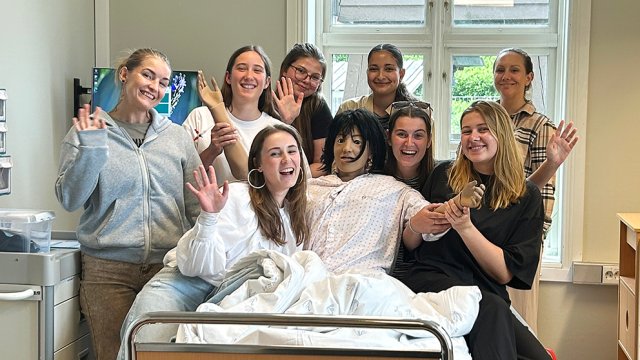
Recently, VID hosted an on-site week as part of a BIP in interdisciplinary simulation. The programme provides an introduction to and overview of interdisciplinary teamwork, patient safety tools, cultural competence, and communication skills in healthcare. Particular emphasis is placed on simulation-based training using standardized patients and simulators.
Participants from Norway, Finland and Belgium
From Norway, six bachelor’s students in nursing participated.
From Finland, the participants included master’s students in Global Health and Crisis Management as well as bachelor’s students in nursing from VID’s partner institutions Diak and Laurea.
From Belgium, the participants were midwifery students, bachelor’s students in nursing, and students of orthopedagogy from Karel de Grote—an academic field that in Norway roughly corresponds to a combination of social education and social work.
A Programme with Extensive Simulation
Some of the students arrived as early as Saturday, 16 May, and had the opportunity to experience the Norwegian Constitution Day celebrations on 17 May.
On Monday, the students were introduced to the programme for the week, and pizza was served to both students and teachers.
On Tuesday, the students took part in simulation-based activities throughout the day, followed by a social programme for teachers in the evening.
Wednesday included simulation-based activities during the day and individual activities in Oslo in the evening.
On Thursday, the programme continued with simulation-based activities and a lecture by Sheena Smith Simensen, a nurse who has served in Ukraine. In the evening, students and teachers went out for dinner together in Oslo.
The programme concluded on Friday with a closing session and evaluation of the BIP.
Part of a Research Project
The simulation week was also part of a research project.
RU‑STRESSed? explores how stress-monitoring devices can support healthcare professionals in assessing workplace stress more accurately. The sensors continuously record physiological signals such as heart rate, heart rate variability, and physical workload.
By combining these objective data with personal experiences and AI-based solutions, the project aims to gain a better understanding of—and eventually be able to predict—what triggers stress.
The project also examines which measures are effective in reducing stress and strengthening resilience.
During this week, students participated in the research by wearing the sensors and taking part in stress‑modulating interventions.