Research: How the Maasai Can Learn About Climate Adaptation
- By: Kjersti Busterud
- Published: September 2nd 2026.
“It is a paradox that some of those who have contributed the least to climate change are among those who suffer the most from its consequences,” says Beth Elise Elness-Hanson.
“The Maasai are traditionally nomadic pastoralists and depend on natural resources that are becoming increasingly scarce. At the same time, they have managed the environment sustainably for countless generations,” she points out.
For the past three years, she has led an EU-funded project among Maasai communities in northern Tanzania. The aim has been to develop an educational programme for local churches on climate adaptation and climate action.
Building on the Maasai Worldview
The decision to use the church as a starting point for education was no coincidence.
“In Norway, you have an excellent social safety net. In rural Tanzania, it is the local church and your neighbours who can help if you are affected by a natural disaster,” she explains.
Working with the church also served another purpose.
“Research has shown that the climate education previously provided to the Maasai had little impact,” she says.
The main reason was that it was based on an understanding of climate that differed from the Maasai’s own experiences and worldview.
“That is why the new lessons were developed in collaboration with local church leaders, allowing the message to come from Maasai to Maasai,” she says.
Working Through Trusted Local Leaders
Looking back, this is what Elness-Hanson is most proud of: that Maasai voices have been brought to the forefront.
“The Maasai have a history of landgrabbing by others seeking the natural resources. How can a researcher like me introduce climate measures without it feeling like someone is once again coming to take their land?” she asks.
The project team developed lessons on creation care together with local theologians and teachers.
The project built on a model developed in the region during the HIV/AIDS pandemic 25 years ago, when trusted local leaders played a key role in sharing information and mobilising communities.
“The collaboration has helped local people realise that climate knowledge is essential if they are to continue living the way they do,” she says.
Songs About Caring for Creation
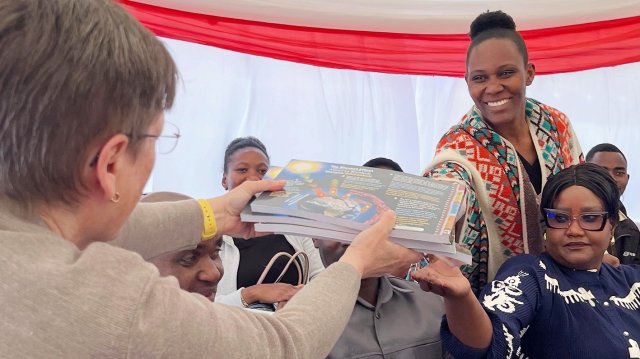
The project has resulted in the book Creation Care in Maasailand, which is distributed free of charge to church and school leaders.
Music has also played a central role in the educational programme. Students and confirmation candidates were invited to write songs about creation care, performed to traditional Maasai melodies.
“Song is the language of the Maasai heart. These songs are an example of how local people adapt the teaching in ways that make sense to them. This will help ensure that the project lives on,” she says.
As part of the project, a choir competition was also organised. The winning songs were professionally recorded and produced as music videos. The videos have been published on YouTube and on the project website, where the educational materials are also available.
Elness-Hanson is currently completing a monograph which will be published later this year. The book presents the project as an effective model for climate change action that can be adapted to other contexts.
Believes the Work Will Continue
In June, Professor Rebecca Solevåg travelled to Tanzania to take part in three dissemination events aimed at each of the project’s target groups: upper secondary schools, confirmation candidates and women’s groups.
The bishop, project staff, authors, partners, and representatives from churches and government authorities were present when the bishop blessed some of the 2,000 copies of Creation Care in Maasailand.
“I was deeply impressed by the events. It was clear that the project is having an impact in the local community. The project will live on as the church uses the lessons within youth groups, women’s groups and in sermons on Sundays,” says Solevåg.